Compact Mechanical Wallet
Product Design & Rapid Prototyping
Background
To be completely honest, this project was about three years in the making. The idea first came to me all the way back in grade 11, when I sent my mechatronics teacher an STL file of a (poorly) designed wallet. I thought the idea was so good because it moved, in my head. I never bothered to check tolerances, or even try building the full thing as an assembly, because I was scared of learning assemblies.
Three years, four iterations, and 50+ hours of CAD later, I finally landed on a design I liked. Truthfully, I'll probably go back to the drawing board in a few months and redesign the whole thing from scratch (I have a habit of thinking up a "new" idea right when I think I'm done), but I'll deal with that when it happens.
Anyway, about the cardholder.
Showcase
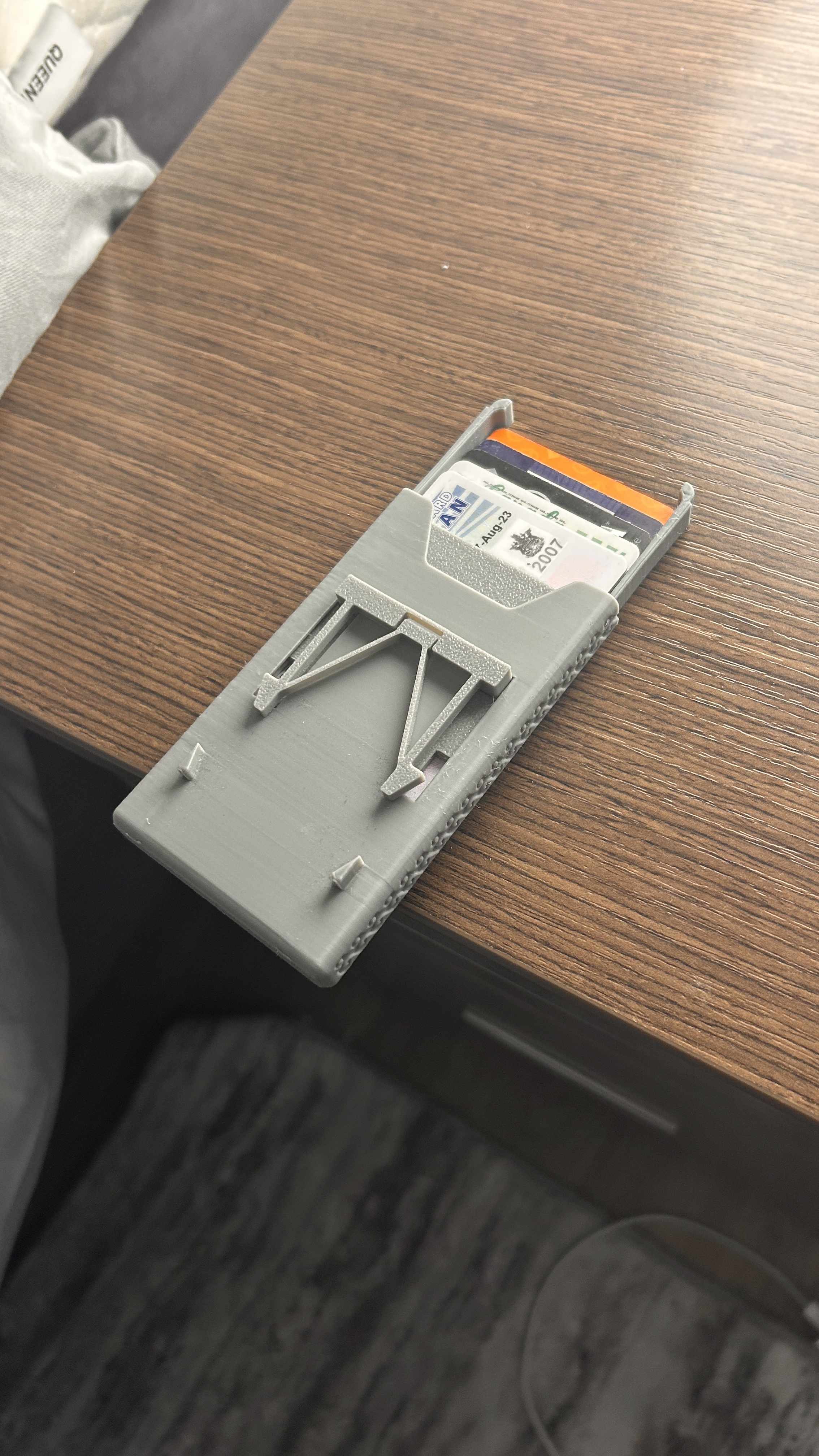
This wallet (or at least the current version) is built around a cascading card design. Instead of digging through a stack to find the card you need, it fans out so every card is visible and easy to grab. It also has a snap-lock mechanism, so once it's closed, the cards stay locked in place and won't slide out even if it's dropped from about head height (I have a habit of tossing and catching whatever's in my hand while walking).
On top of that, it's packed with a few extra features: a built-in AirTag mount, which was very important to me (I've managed to lose more water bottles than I've bought), a money clip for cash, and a clip for keys and a lanyard.
Design Timeline
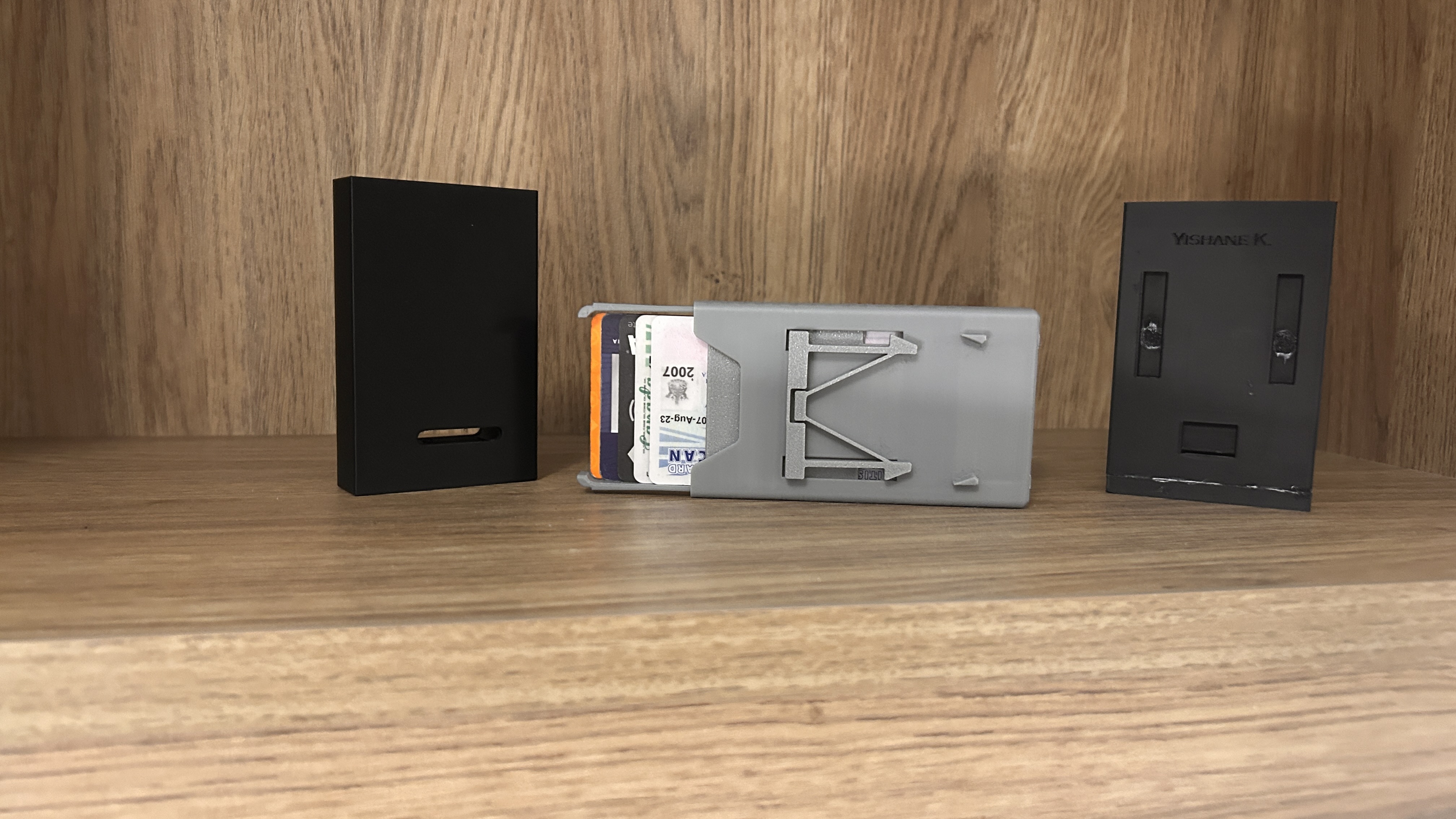
There's another early design missing from the photo that I couldn't find, so I'll just explain what each one had.
1st Design (Early Concept)
This one came straight out of my imagination, I really thought it would work, but after enough failed first drafts, I've learned I need to sketch ideas out before jumping into CAD. It fundamentally worked, aside from being way too big. The concept was a sliding pin paired with repelling magnets to pop the cards out, but I realized there was a good chance the cards would just slip out of the wallet entirely, so I had to iterate (in this case, come up with an entirely different design).
2nd Design
Honestly, I don't know where I was going with this one — I just didn't think the whole design through. The moment it came off the printer, I realized my mistake: cards have width (they're not infinitely thin), and that width pushed against the so-called snap-lock mechanism, jamming it permanently locked. I genuinely can't recall what I was thinking when I designed this — I just remember the moment of realization when I tried to use it and discovered the wallet does not, in fact, give your cards back unless you pay it.
3rd Design
This was my first functionally successful design. It has a snap-lock mechanism and two "prongs" that hold the cards in place when locked, still using repelling magnets to pop the cards up when unlocked. I fundamentally liked this one, and it also had a money clip for cash. The problem: getting a single card out meant pulling the whole block out and sifting through it by hand, which I didn't like, so I went back to the drawing board again.
Final Design
It took me longer than I'd like to admit to land on the cascading card design.I took inspiration from the many wallet ads that kept showing up in my feed and was able to work out this version.
What I Learned
I learned a lot working through this project, but the biggest lesson was to slow down. I rushed through the design stage more than once and wasted filament because of it. That said, I really enjoyed the process, and I'm happy with what came out of it (for now).