Claw Kent
Robotic Retrieval System
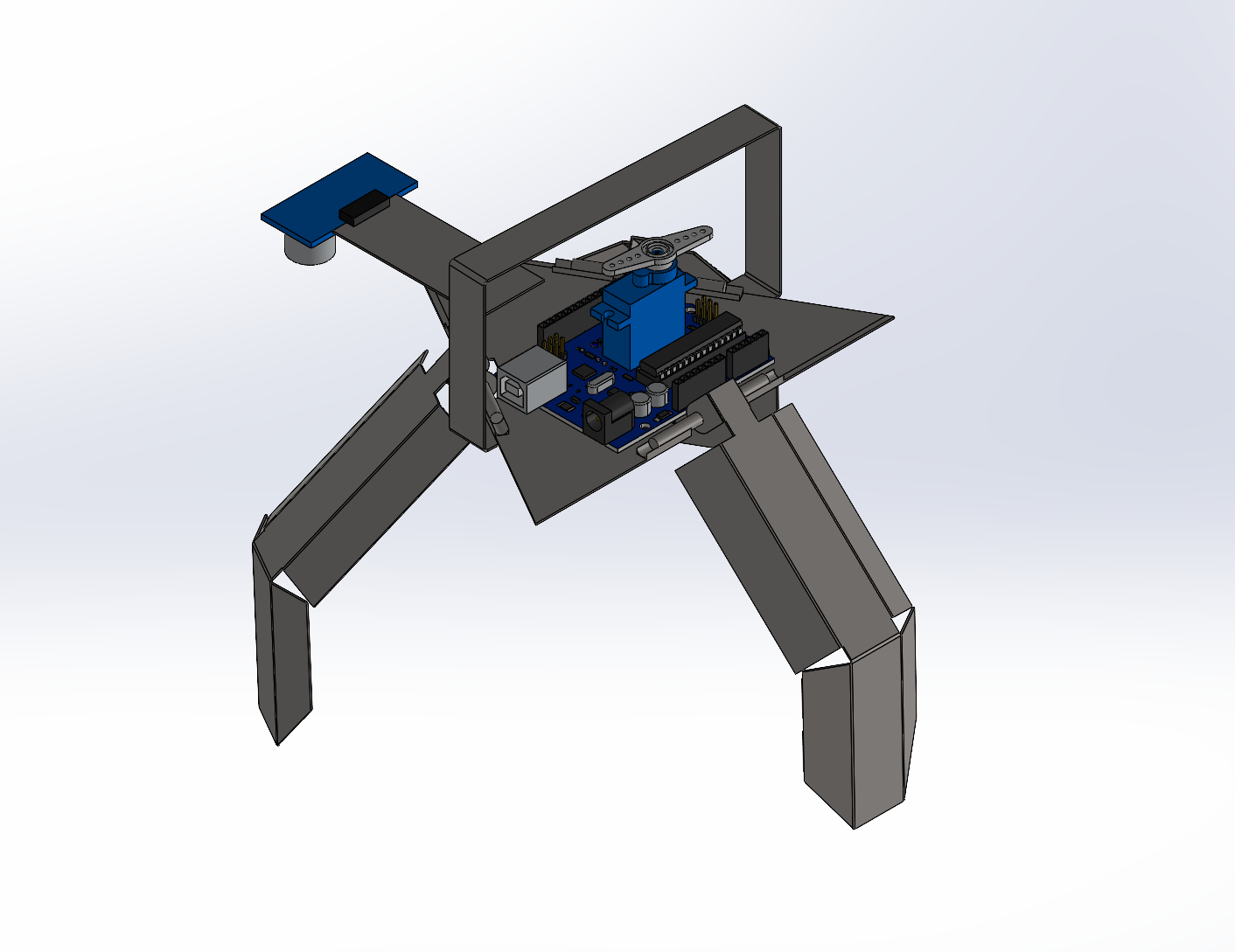
Background
Claw Kent started life as a project for APSC 101, UBC Engineering's first-year design course, where the brief was to build a retrieval device that could grab an object using sensor feedback.
The materials used mainly consisted of sheet metal, and whatever fasteners and adhesives I could manage to steal from other teams in my studio (i'm kidding, they were freely given out). For this project, I was responsible for the mechanical design, the programming, and sensor integration. For some reason, I thought that it would be a good idea to use rubber bands to actuate the claw, and the servo to open it, a terrible idea that I will never use again.
Showcase
At its core, Claw Kent is a three-legged sheet-metal chassis with a rubber band actuated claw and an ultrasonic sonar sensor standing in for eyes (ears, technically, since sonar doesn't really "see" anything). We were given a crane to use to operate and hover the claw over the intended target.(the crane was very difficult to operate with our set up something I should have planned for, but didn't), but the grip itself is sensor-driven rather than manually triggered.
Design & Build
The idea for Claw Kent actually started in a C-Sketch session with my team: everyone sketches out an idea, passes it along, and the next person builds on it (or quietly replaces it) until something workable falls out the other end. From there, I built the thing for real first: cutting and bending sheet metal, figuring out fit and fasteners by hand. SolidWorks came after, not before. Once the physical claw existed, I modeled it in SolidWorks to actually document what I'd built, which is a fairly backwards way to use CAD but did mean I never had to guess whether a part would fit. Structural adhesive of choice throughout: tape, applied with the confidence of someone (me) who has decided tape is, actually, a structural material.
Sensing & Control Logic
Positioning is all human. Someone runs the crane and lowers the claw by string until it's roughly over the target. From there, the sonar sensor takes over for the grip: it feeds distance readings to the control board, which decides whether something is actually close enough to grab, rather than needing a separate manual "grab now" signal. Tuning that threshold took some trial and error.
What I Learned
Claw Kent taught me the basics of pairing a sensor with real mechanical actuation, and that tape is a perfectly legitimate fastener when the deadline is at 9am (for now). It was also a good first taste of the whole design-build-test loop that APSC 101 is built around.